Date published
10 July 2026
In the food industry, product quality does not end at the production stage. It is equally important what condition the product is in when it reaches the recipient after storage and thawing. It is the freezing process that largely determines whether meat retains its juiciness, fish its delicate structure, and vegetables their natural appearance and proper texture.
Today, modern Individual Quick Freezing (IQF) technologies play a much greater role than just extending the shelf life of products. Their task is primarily to preserve the quality developed in the earlier stages of production and to limit losses that can affect the profitability of the entire process.
Why does the freezing method matter so much?
During freezing, the water inside the product turns into ice crystals. If the process is too slow, large crystals form, which damage the cellular structure of meat, fish, or vegetables. Upon thawing, this leads to significant drip loss, degradation of texture, and loss of sensory attributes.
IQF technology is based on very rapid heat extraction from the product, resulting in the formation of much smaller ice crystals. This allows for preserving cell integrity and limiting damage to the product’s structure.
The effect is visible right after thawing – the product remains firmer, retains its natural appearance, proper consistency, and greater juiciness.
Less moisture loss means higher profit
One of the most important aspects of the freezing process is limiting moisture loss. Water is a natural component of most food products, which is why its loss means not only quality degradation but also real economic losses.
Every percentage of mass loss translates into a smaller amount of product available for sale. In plants processing hundreds or thousands of tons of raw material per year, even small differences in yield can mean significant savings.
Limiting product dehydration allows for:
- increasing production yield,
- minimizing thaw loss and retaining higher product mass,
- reducing raw material losses,
- improving the profitability of the entire process.
Therefore, modern freezing technologies should be viewed not only as an element of refrigeration but also as a tool for production cost optimization.
Better quality means higher product value
Today’s recipients look not only at the price but also at the appearance of the product after thawing and preparation.
A high-quality product should:
- retain its natural color,
- have a firm structure,
- show minimal drip loss,
- retain proper juiciness,
- undergo further thermal processing uniformly.
This is of particular importance in the case of premium products, where appearance and quality directly influence purchasing decisions and brand perception.
Benefits for multiple food industry sectors
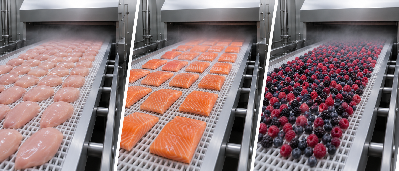
IQF technology finds application in many branches of the food industry. It works perfectly for freezing:
- meat and poultry,
- fish and seafood,
- vegetables,
- fruits,
- breaded products,
- ready meals,
- components used in further processing.
In each of these applications, the goal is to preserve product quality while ensuring high process efficiency.
Fewer complaints and higher customer satisfaction
The quality of the freezing process also affects end-user satisfaction. Products that retain their structure and appearance after thawing are rated better by customers, undergo further processing more easily, and present higher quality on the store shelf and in gastronomy.
Reducing drip loss and maintaining the proper texture reduce the risk of complaints and allow manufacturers to build a reputation based on repeatable quality.
IQF is an investment in quality and efficiency
Modern individual quick freezing technologies do not create product quality – they allow it to be preserved. It is thanks to an appropriately designed process that it is possible to reduce raw material losses, maintain high yield, and deliver a product that retains its natural properties after thawing.
In environment of rising production costs and increasing market expectations, appropriate freezing technology becomes one of the key elements of competitive advantage. It is an investment that translates not only into the quality of the final product but also into the efficiency of the entire production process and the long-term profitability of the enterprise.